Samuel C. Buckner
Graduate Researcher in Autonomous Systems
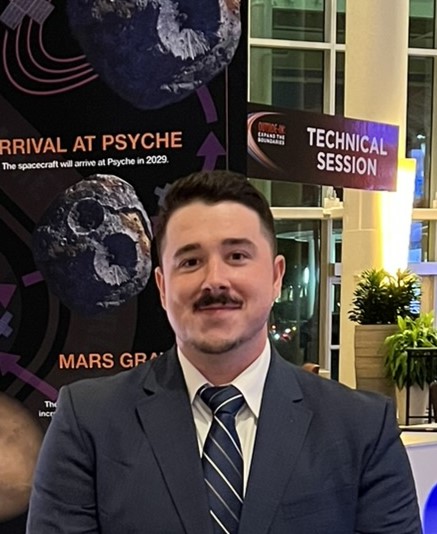
I am a fifth-year Ph.D. student in the Aeronautics & Astronautics Department at the University of Washington, working with the Autonomous Controls Laboratory under Dr. Behçet Açıkmeşe. My research interests are divided between developing practical, real-time numerical algorithms and applying them to relevant real-world scenarios in aerospace engineering and, more broadly, in autonomous systems. Some of my focus areas include:
- Convex Optimization (Convex Approximation Methods, Sequential Convex Programming)
- Real-Time Trajectory Optimization
- Interaction-Aware Planning (Contact-Rich, Perception-In-The-Loop)
- Application Domains:
- Robotics: Multibody Systems, Legged Locomotion
- Spaceflight: Powered Descent Guidance, Relative Orbital Maneuvers
- Aeronautics: Multirotors, eVTOLs
Academically, I graduated Summa Cum Laude from the University of Florida with a B.S. in Aerospace Engineering (2020), and am the recipient of both the NSF GRFP and ARCS fellowships for graduate research. My internship experience is divided between NASA as a Pathways Co-Op (6x), Blue Origin (2x), and Mitsubishi Electric Research Laboratories (1x). Have a look through my website to learn more!
Research Showcase
CI-SCvx: Contact-Implicit Successive Convexification
A new approach to contact-implicit trajectory optimization (CITO) using integrator states to exactly encode contact modalities on sparse optimization time grids, developed partially during my internship at MERL. This includes a general-purpose Python toolbox customized for CITO problems with GPU acceleration using the JAX library, and has been deployed on notable locomotion challenge problems in high-fidelity physics simulators.
ACT-SLAM: Active Continuous-Time SLAM
An extension on the well-known active SLAM problem to continuous-time optimal control using stochastic trajectory optimization modeling, with demonstrated reliability and improvements over benchmark methods on a lunar landing challenge problem. This work received Best Paper in the GNC Graduate Student Paper Competition at SciTech 2026—read here to learn more.
Graph-SCvx: Graph Successive Convexification
A general-purpose method for constructing graphs of trajectory optimization problems, leading to a tractable formulation for contingency planning under unknown multimodal uncertainty. The resulting technique demonstrates substantial solve-time improvements relative to its predecessor, along with improved success rates for quadrotor landing in hazardous terrain conditions and hardware experiments to further validate the approach (manuscript not yet approved for distribution).
Perceptive Set Containment for Powered Descent Guidance
A novel approach to modeling terrain scanning constraints for powered landing maneuvers using a new theory of constrained conic intersections. The work spans both a high-fidelity 6-DoF formulation via sequential convex programming and a 3-DoF formulation via lossless convexification, developed in part during work rotations at NASA Johnson Space Center.
HALO: Hazard-Aware Landing Optimization
A combined perception (HALSS) and trajectory planning (Adaptive-DDTO) solution for contingency planning in landing maneuvers with multiple candidate landing sites. This was an equal-contribution project with Chris Hayner, published and presented at ICRA 2023, where I led the development of the Adaptive-DDTO algorithm.
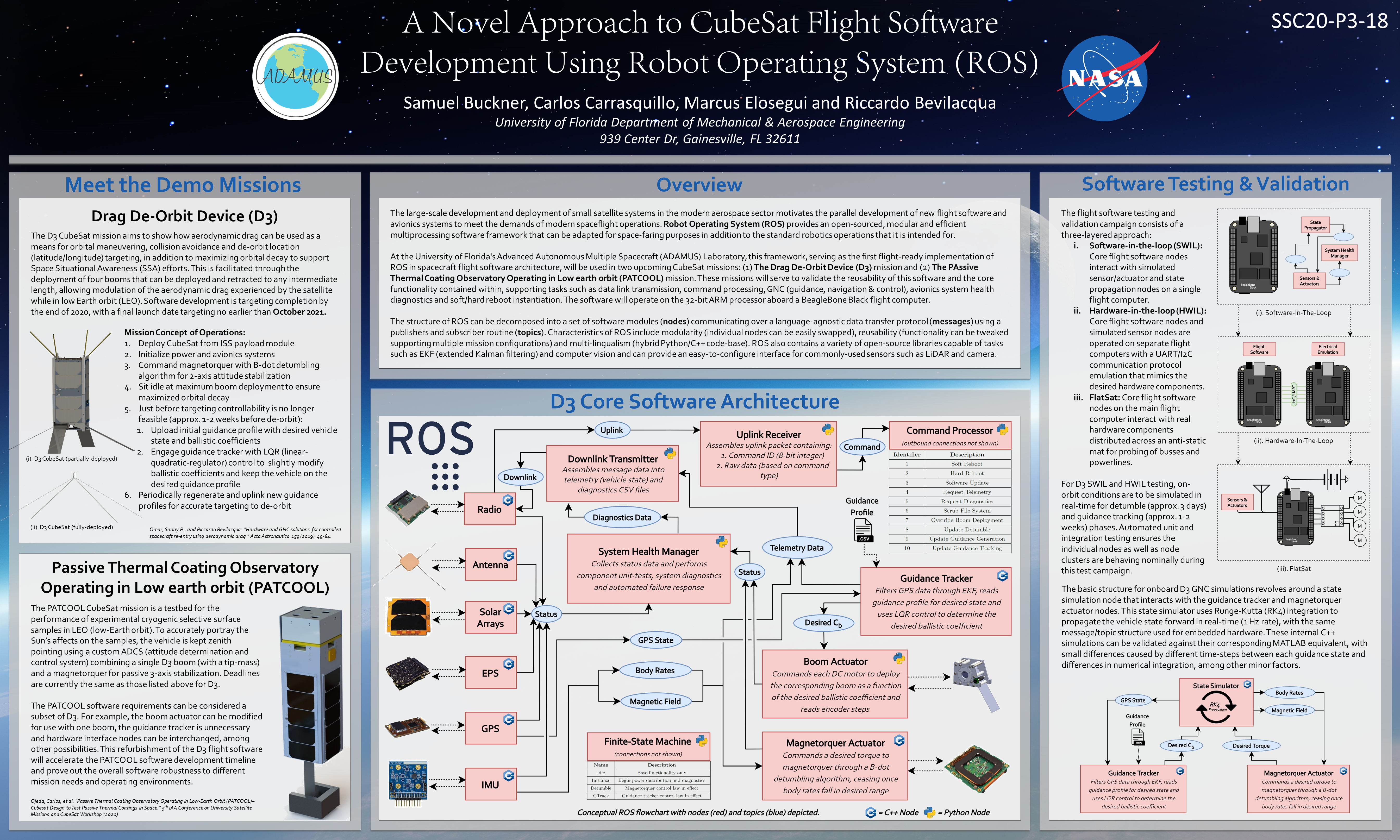
ROS-Based Flight Software for the D3 CubeSat Mission
The first flight-ready ROS (Robot Operating System) based flight software for a CubeSat, developed as the lead flight software engineer for the D3 (Drag De-orbit Device) mission. The software supports radio telemetry, GPS navigation, finite-state handling, command processing, onboard updates, and failsafe reboots; D3 was successfully launched in July 2022 and completed all mission requirements in April 2023.